How Every Jam in Phish History Got a Start Time.
A new switch in the top bar plays every track from the jam. Behind it, there's a hand-marked start time on every jam in Phish history. Here's the methodology.
There's a new toggle in the nav at the top of every page: Jam Mode. Flip it, and every play across the site starts at the jam instead of the intro (including playlists!).
Visually, there are a couple things to point out:
1. When Jam Mode is activated, the waveforms dim up to the point where the jam begins.
2. Regardless of whether Jam Mode is activated, you'll notice that there is now a 'Jam In' marker on all waveforms if you'd rather click to the entry point manually.
Now, let's talk a little about the information that the switch depends on: getting the actual jam start times.
Over the course of many months, I went through Phish's entire live catalog one track at a time by hand. From over 37,000 tracks, I marked more than 20,000 jams on my phone whenever I had a free moment: sitting at traffic lights, doing the dishes, watching my kid's sporting events, etc. For a long time, this process became a true part of my life.
What follows is the methodology: the calls are opinionated, and as with all data on this site, I want to be transparent with what's behind the marker.
Every jam start time was placed by hand, one track at a time. Here is what that looks like on a real waveform — the 27-minute Simple from Chicago, 2017. Watch the marker land.
37,000+ tracks, one at a time. Software can't hear the turn — an experienced listener has to. The energy bars render, top to bottom, no marker yet.
A jam is at least a minute of musical improvisation, with no lyrics over it. Do enough versions of a song and you develop a feel for where the jam approximately sits in the waveform — the back third here.
The marker goes where a listener wants to drop in. Where it's debatable, listener experience wins — the way it sits on Taste, at the composed outro. Everything before it dims back.
Obvious no-jam takes get bucketed by length and played straight. And the same song gets the same structural cut every time — a David Bowie always gets its marker in the same place, so every version is comparable.
I built a tool that looks like this:
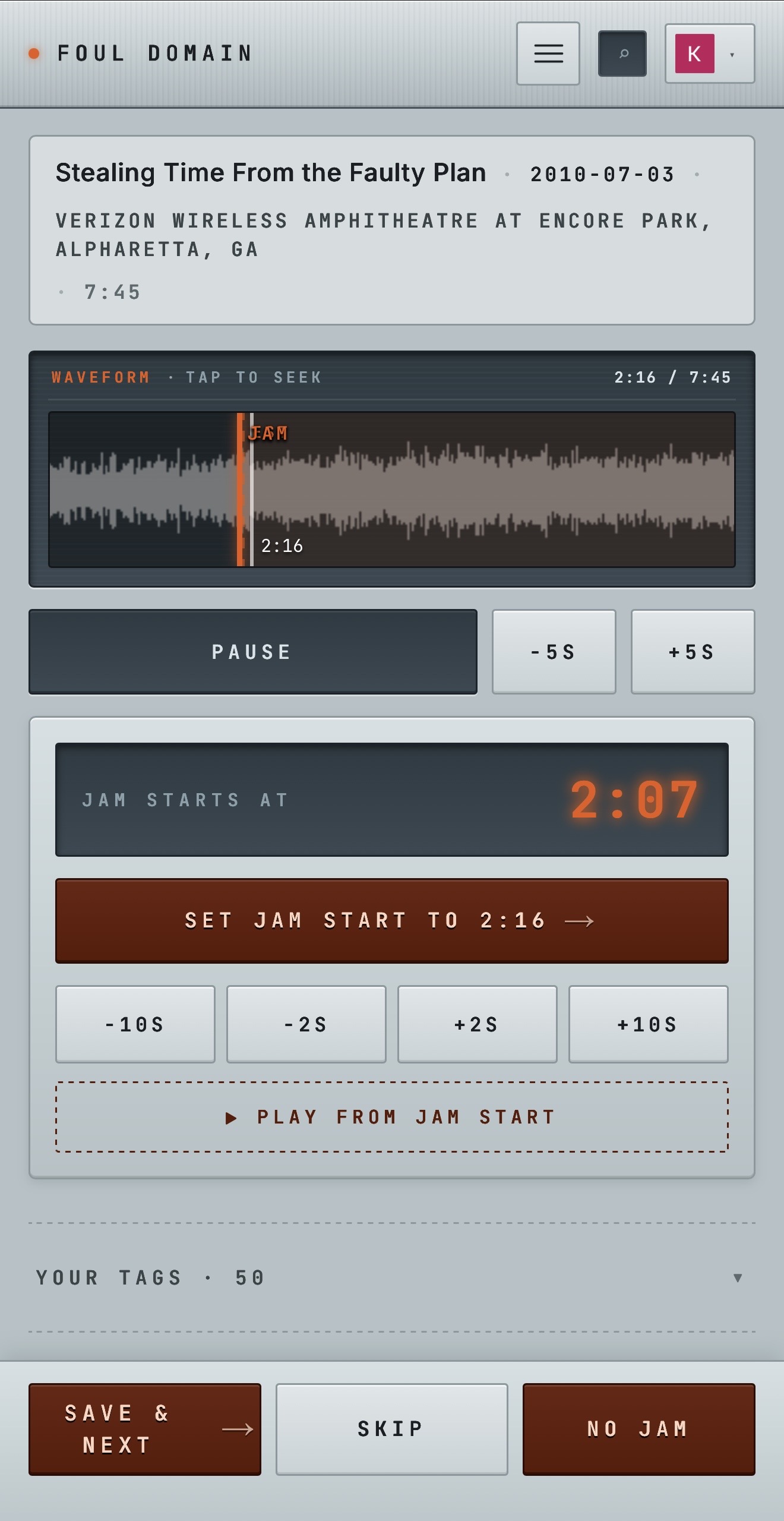
It gave me one track at a time, batched by song, and sorted by volume. Since You Enjoy Myself has been played the most, I started there, with the earliest performance. Then I went through every You Enjoy Myself, one by one, and placed the marker on the second the jam starts. When that was done, it queued up all the Possums, then the Mike's Songs, and so on. Doing all versions of each song like this was necessary for consistency between tracks, and for speed (you get to develop a feel for where the jam approximately sits in the waveform).
And it was done like this the whole through: a lot of long days and late nights.
Why hands and not software
I wanted it to be reliable. Phish's music is so fluid and the moment a song turns into a jam is often hard to describe: it takes an experienced listener who understands how the band communicates to flag the moment when they're dropping into something. The only way to get it right is for someone who knows the music to listen for it. So that's what happened.
But “hand-tagged” isn't the same as “listened end-to-end to every track.” It was a process, and it had rules.
The rules
Every track, one at a time (but not every track from beginning to end).
I sat with the catalog one performance at a time. For songs that follow a known structural arc, I knew their average length: for example, a “Bouncing Around the Room” is typically around three and a half minutes, and there's no jam to find. If a take fell inside that normal envelope, I marked it as no jam without listening and moved on. If it ran significantly longer, I went back and listened. (In Bouncing's case, the extra time always turned out to be crowd noise on the tape; into the no jam bucket those went as well.) The shortcut was the song's own historical fingerprint.
A jam is at least a minute of musical improvisation, with no lyrics over it.
That's the working floor. Below that and it isn't really a jam: it's a bridge, an outro, an ending vamp. The minute isn't a strict bar; gut judgment decided the close calls.
Some songs don't fit the jam/composed split.
“2001” is a continuous jam built around a recurring theme. There's no “composed section” to skip past; the whole thing is the jam.
As another extreme, the jazz standards Phish has played over the years (eg: Caravan, Take the A Train), are composed-and-improvised in the same breath. There's nowhere honest to draw a line between “song” and “jam.”
Songs like the above were excluded from the system entirely.
Where it's debatable, listener experience wins.
"Taste" is a good example to share. Technically the jam doesn't start where I put the marker: it's the start of the composed outro.
But in this listener's opinion, the composed outro of Taste isn't separable from what follows; it's the same thought. Starting the jam after it makes the playback feel wrong. So the marker goes earlier than someone else might place it, and I'll take the criticism. I put it where I felt it gave the best listening experience.
The question I asked at every borderline call wasn't “what's technically correct?” — it was “what do I, as a listener, actually want?”
Here's an example "Taste" so you can see what I mean.
The marker you watched get placed is one you can now hear. This is the hand-tagged Taste — cued to the jam-in marker on the composed outro, because that is where it feels right to drop in.
Same song, same structural cut, every time.
A “David Bowie” sometimes has an intro jam. Most nights it doesn't. For consistency, every Bowie gets its marker in the same structural place, even on the nights when there's improv before that point, because the per-song analysis I'm planning leans on having a single, comparable structural reference across every version. Otherwise you're not measuring the same thing twice.
What this is for
The first thing it powers is the Jam Mode toggle from the opener. The next things are bigger: scoring built on the jam itself rather than the whole track, and a weekly series of posts that take one song at a time and walk through what its jam history actually looks like.
For now: flip the switch, press play, skip to the fun part!